
Have you ever wondered why some websites easily show up on the first page of Google while other websites stay hidden? Many web owners look at a special metric called “Domain Authority” to figure this out.
If you are new to search engine optimization, which means making your site easier for Google to find, understanding authority numbers can feel confusing. You might ask yourself, whats a good domain authority score to aim for when you are just starting?
This beginner guide will explain what authority numbers mean, how software platforms calculate them, and how you can slowly improve your score over time.
What is Domain Authority
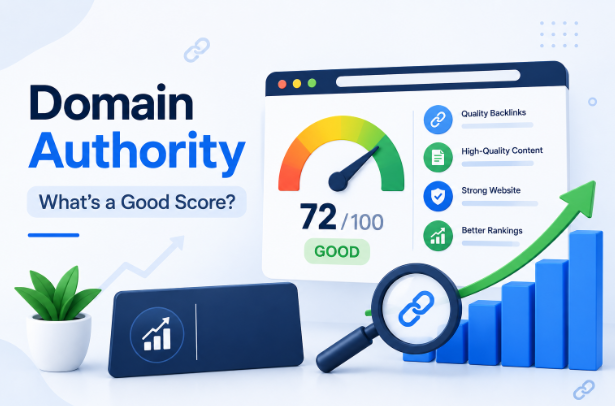
Domain authority is a metric created by a digital marketing company called Moz. It measures how strong a website is on a scale from 1 to 100. A high score means a website has a strong chance of ranking high on search engine result pages, while a low score means the website might struggle to rank against tough competitors.
Think of domain authority like a high school reputation score. If a student is well known and trusted by lots of other popular students, people listen to them. In the online world, if a website is linked to by many other trusted websites, search platforms view it as more reliable. These connections are called backlinks. A backlink is simply a link on an outside site that points users directly to your web pages.
It is important to remember that domain authority is an independent metric, not an official score created by Google. Google does not use Moz’s calculation to place pages in search results. Instead, marketers use this number as a simple guide to compare their website against competitor sites in the same industry.
How Moz Calculates Your Domain Authority Score
Moz uses machine learning software to calculate your score by studying your overall backlink profile. A backlink profile includes every single link pointing to your site from other places on the web.
Moz looks at several main factors to calculate your number:
- Total Link Count: How many individual links point back to your web pages.
- Referring Domains: The number of unique websites linking to you. Ten links from ten different websites carry more value than ten links from the same website.
- Link Quality: The authority score of the sites that link to you. A single link from a famous news site carries far more power than twenty links from small blogs.
Moz combines these factors using a logarithmic scale. A logarithmic scale means it is much easier to raise your score from 10 to 20 than it is to grow your score from 70 to 80. As your score gets higher, moving up even a single point requires earning dozens of high-quality links.
Whats a Good Domain Authority Score
A good score depends entirely on your online competitors. There is no single magic number that guarantees success for every website.
If your close business rivals have scores around 20, having a score of 25 is great. But if your rivals are huge media companies with scores of 80, a score of 25 will make it hard to compete for the same keywords.
The Truth About Domain Scores Between 0 and 100
Many website owners get upset when their score stays low during their first year online. It is completely normal for a brand-new website to start at a score of 1. You should view domain authority as a comparative score rather than a grade on a school test. Getting a 50 out of 100 on a test might seem bad, but having a score of 50 for a niche blog can actually be impressive.
Domain Authority Tiers Breakdown
Looking at general metric tiers can help you see where your website currently sits in the digital landscape.
Scores From 0 to 20 for New Websites
Scores in this range belong to newly launched websites, small local businesses, or blogs that have not built many external links yet. Sites in this group usually only rank for very specific, low-competition phrases.
Scores From 21 to 40 for Growing Niche Sites
This tier represents growing sites that regularly publish original content. These websites have earned links from small blogs, directory listings, and local business partners. They can rank easily for long-tail keywords, which are specific search queries containing three or more words.
Scores From 41 to 60 for Established Brands
Websites in this group have built strong brand recognition online. They feature extensive content collections and frequently receive links from popular blogs, industry magazines, and news portals.
Scores Above 60 for High Authority Industry Leaders
Scores above 60 belong to well-known internet platforms, major media publications, and government organizations. Sites like Wikipedia, news outlets, and global tech brands sit in this top bracket.
How Domain Authority Compares to Domain Rating and Authority Score
Moz is not the only company that calculates website strength. Other popular digital marketing tools have built their own independent authority metrics. Because each platform uses its own crawlers and data formulas, your score will vary depending on which software program you use.
Ahrefs Domain Rating
Domain Rating is an authority metric created by Ahrefs. Similar to Moz, it measures link strength on a 0 to 100 scale. However, Ahrefs calculates this number by focusing strictly on unique dofollow referring domains.
A dofollow link is a standard hyperlink that allows search engine robots to pass ranking credit to the destination website. If one website links to you hundreds of times, Ahrefs still counts that as only one referring domain, keeping the metric focused on unique link sources.
Semrush Authority Score
Authority Score is the primary strength metric created by Semrush. Unlike tools that look mostly at links, Semrush uses a combined formula that includes three main elements:
- Link Data: The total number of unique linking websites and dofollow connections.
- Organic Search Traffic: Estimated monthly visitors coming to the website from regular Google searches.
- Spam Factors: Red flags like suspicious link patterns or sudden spikes in low-quality web links.
By combining organic traffic estimates with backlink numbers, Semrush attempts to keep users from artificially inflating their metric scores.
Proven Strategies to Increase Your Domain Authority Score in 2026
Improving your metric score requires time, effort, and high-quality web pages. There are no quick shortcuts to building real web authority.
Earn Links From Relevant Sites
The best way to boost your authority score is to earn links from trusted websites in your specific industry. Writing helpful guides, sharing original research data, or creating free resources makes other site owners want to link to your content naturally.
Focus on niche relevance rather than chasing any random link. Search engine behavior research shows that pages ranking in position one on Google have an average of 3.8 times more backlinks than pages in positions two through ten. Earning steady, relevant links helps both your search positions and your third-party authority scores.
Clean Up a Weak Backlink Profile
Sometimes low-quality or spammy websites link to your pages without your permission. Having too many low-quality links can hurt your online credibility.
Using backlink audit tools allows you to inspect your link profile and identify suspicious links. If low-quality websites are linking to you, you can reach out to those site owners and ask them to remove the links. You can also use Google’s disallow tools to tell search engines to ignore those bad connections.
Strengthen Internal Linking
Internal links are hyperlinks that connect one page on your website to another page on the very same site. Developing a logical internal linking structure helps spread link power across your entire domain.
When a popular article on your site earns a strong external backlink, adding internal links inside that article to your newer blog posts passes value down to those new pages. This helps search engine crawlers find your new content faster.
Conclusion
So whats a good domain authority score in the end? It depends entirely on your industry, your competitors, and where your site currently stands, but a score in the 30s already places you close to the average website online.
Rather than chasing a specific number, focus on steady link building, clean backlink habits, and content that actually earns attention, since the score tends to rise naturally as those efforts pay off. Give it time, stay consistent, and check your progress every few months instead of obsessing over daily changes.
Frequently Asked Questions
Is Domain Authority an Official Google Ranking Factor
Domain authority is not an official Google ranking factor. It is a third-party metric created by Moz to estimate website ranking potential. Google uses its own hidden algorithm signals to determine page rankings.
How Long Does It Take to Boost Your Domain Rating
Boosting your authority score usually takes several months of consistent work. Because metrics update periodically as web crawlers find new links across the internet, it often takes 3 to 6 months to see steady score growth after acquiring new backlinks.
Whats A Good Domain Authority Score for a Brand New Site
For a brand-new website, any score between 1 and 15 is completely normal. New sites take time to get indexed by search engines and build initial backlink profiles. Focus on publishing helpful content before worrying about your starting score.
Is It Possible to Reach a Perfect 100 Score
A perfect 100 score is reserved for massive internet platforms like Google, YouTube, and major social networks. Most successful business websites aim for a solid score between 30 and 60 within their specific industry niche.
Can You Increase Your Score Without Buying Backlinks
You can easily increase your score without buying backlinks. Creating original research, offering free tools, publishing long-form guides, and guest writing for industry blogs are safe, natural ways to earn links without paying money.
Ali Haider
Ali Haider is a Link Building Manager with 7 years of experience in SEO, digital outreach, and authority-building strategies. He specializes in developing effective link acquisition campaigns, managing outreach processes, and helping websites improve their online visibility through sustainable SEO practices.