
TL;DR
- 62.4% of SaaS startups had no measurable organic traffic after 1 year.
- Only 10.3% reached 1,000+ monthly visits, and just 4.3% crossed 10,000+.
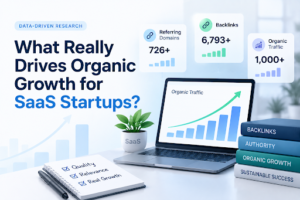
- SaaS startups reaching 1,000+ monthly visits typically had 726+ referring domains and 6,793+ backlinks.
- SaaS startups reaching 10,000+ monthly visits typically had 1,000+ referring domains and 15,700+ backlinks.
- More backlinks ≠ more success; relevance and quality matter more than volume.
Strategic SaaS link building helps brands earn authority across search engines, AI platforms, and the wider web.
Quick Summary
Get Pro Links analyzed 700+ SaaS startups launched within the last year (up to August 2025) by extracting companies from Product Hunt and evaluating their backlink profiles through Ahrefs. The research reveals how link building impacts SaaS startup growth, with insights into referring domains, backlink authority, and organic traffic performance. The findings highlight why building high-quality backlinks early can help SaaS startups improve visibility, establish authority, and compete in search results.
It has never been easier to build software. It may also have never been harder to make a new software product stand out.
AI-assisted development has moved from novelty to normal workflow remarkably quickly. JetBrains’ 2026 Developer Ecosystem research, based on more than 15,000 professional developers, found that by May–July 2026, 90% were using AI coding agents at work at least weekly and 68% were using them daily. Developers also reported that a significant share of the code they produced was now generated or assisted by AI.
That shift has changed the economics of launching a SaaS startup. A founder who once needed a development team and months of engineering can now prototype, test and ship a product much faster. Vibe coding, coding agents and low-code infrastructure have lowered the barrier to entry, but they have not lowered the barrier to distribution.
If anything, the opposite is happening.
Product Hunt is not a SaaS-only platform, so its numbers should not be confused with a global count of SaaS startups. But its launch activity gives a useful indication of how crowded the technology market has become. Product Hunt tracking data shows more than 19,000 products were submitted in the latest 30-day period, while July 2026 became the busiest month in its recorded history with more than 21,000 launches.
For SaaS founders, the problem is therefore shifting from Can we build it? to How will anyone find us?
That is one of the reasons link building remains so important for SaaS startups in 2026.
Link Building Helps a New SaaS Brand Earn the Authority It Does Not Yet Have
A newly launched SaaS website starts with an obvious disadvantage. Established competitors may have spent five or ten years publishing content, being discussed by customers, attracting media coverage, forming partnerships and earning backlinks. A startup might have a better product or a better article, but it does not automatically inherit the authority those competitors have accumulated.
Backlinks help reduce that gap.
Google continues to describe links as signals it uses to understand the relevance of pages and as one of the ways it discovers new pages on the web. The surrounding context and anchor text can also help people and search engines understand what the destination page is about.
This doesn’t mean Google calculates rankings by simply counting backlinks. Modern search is far more complex than that. It means links remain part of the wider system of signals that tell search engines a website is being referenced elsewhere rather than making claims about itself in isolation.
Our own research illustrates how significant that distinction can become in the first year of a SaaS product’s life.
For this study, Get Pro Links analyzed 718 SaaS products launched through Product Hunt in August 2025 and examined their organic visibility and backlink profiles using Ahrefs roughly one year later. We looked at metrics including referring domains, backlinks, Domain Rating, organic keywords and estimated organic traffic.
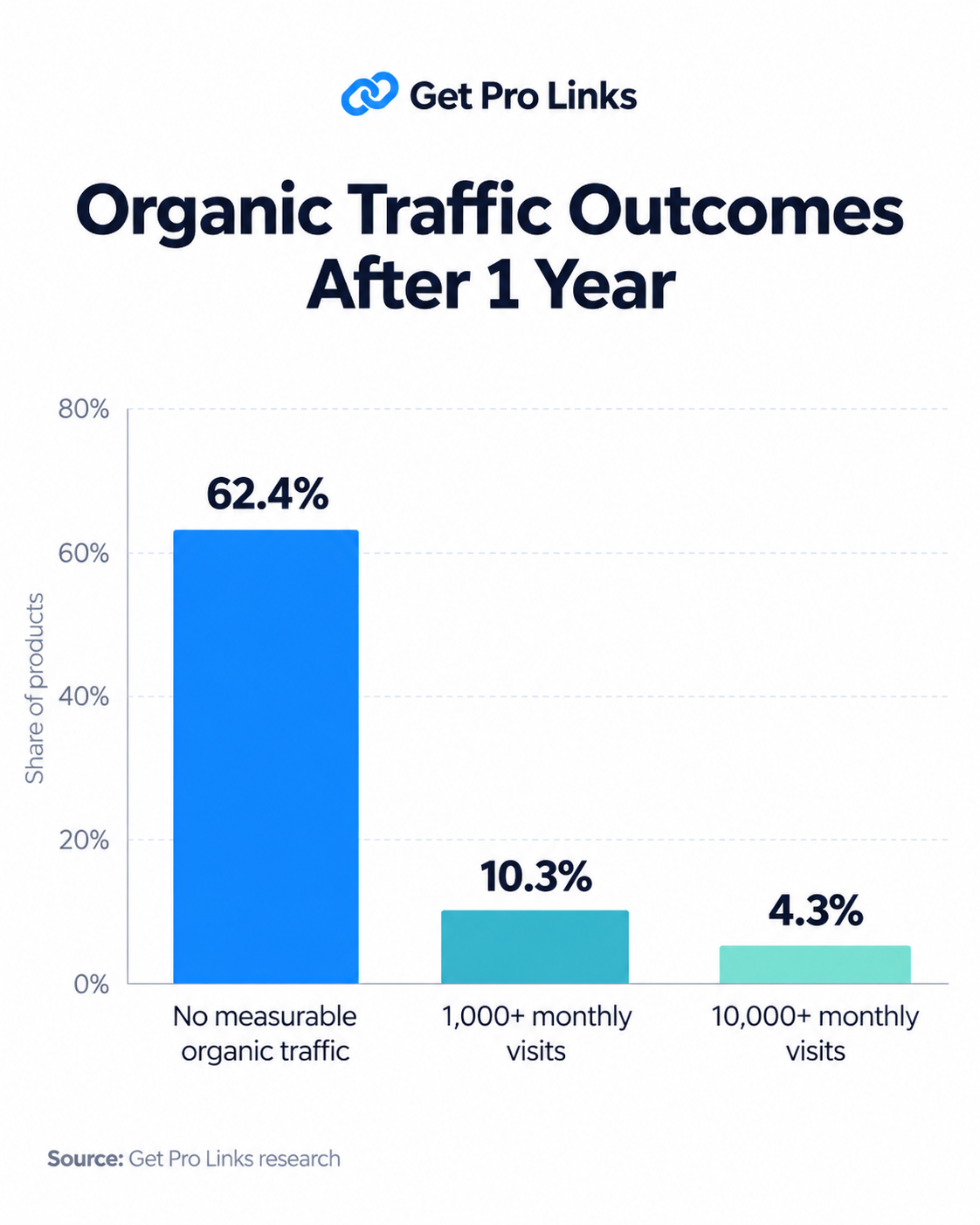
The most striking starting point was that 62.4% of the products had no measurable organic traffic after approximately one year. Only 10.3% had reached at least 1,000 estimated organic visits per month, and just 4.3% had crossed 10,000 monthly visits.
Backlinks were not the only difference between the winners and everyone else, but their backlink profiles were difficult to ignore.
SaaS Startups With Broader Backlink Profiles Were Far More Likely to Gain Organic Traffic
One of the clearest relationships in the study appeared when we grouped the startups by referring-domain strength.
Among the bottom 25% of SaaS websites by referring domains, only 13.8% had developed any measurable organic traffic, and just 1.1% had crossed 1,000 estimated monthly visits after roughly a year.
For the top 25% by referring domains, the picture was dramatically different. 72% had measurable organic traffic and 32.4% had passed 1,000 monthly visits.
Put another way, SaaS products in the top referring-domain quartile were around 29 times more likely to have reached 1,000 monthly organic visits than those in the bottom quartile.
That does not establish backlinks as the sole cause of growth. A stronger product may attract more coverage. A company investing seriously in SEO may simultaneously publish better content and build better links. Brand demand, category size, technical SEO and keyword competition all matter.
But for a SaaS founder deciding whether link building deserves a place in the growth strategy, the pattern is meaningful. The websites that had built a wider footprint across the web were substantially more likely to have developed search visibility.
Links Matter Most When They Support Pages With Commercial Potential
The value of SaaS SEO is not simply traffic. It is the ability to appear while potential customers are researching a problem or evaluating software.
Consider searches such as “best payroll software for startups,” “CRM for recruitment agencies,” “Notion alternatives,” “AI customer support platform,” or “[Competitor A] vs [Competitor B].” These queries sit much closer to a purchase decision than a generic informational search.
They are also often difficult to rank for.
A young SaaS company may create an excellent comparison page or use-case page only to find itself competing against established vendors, review platforms and publishers with years of accumulated authority.
This is where strategic link building can change the competitive equation.
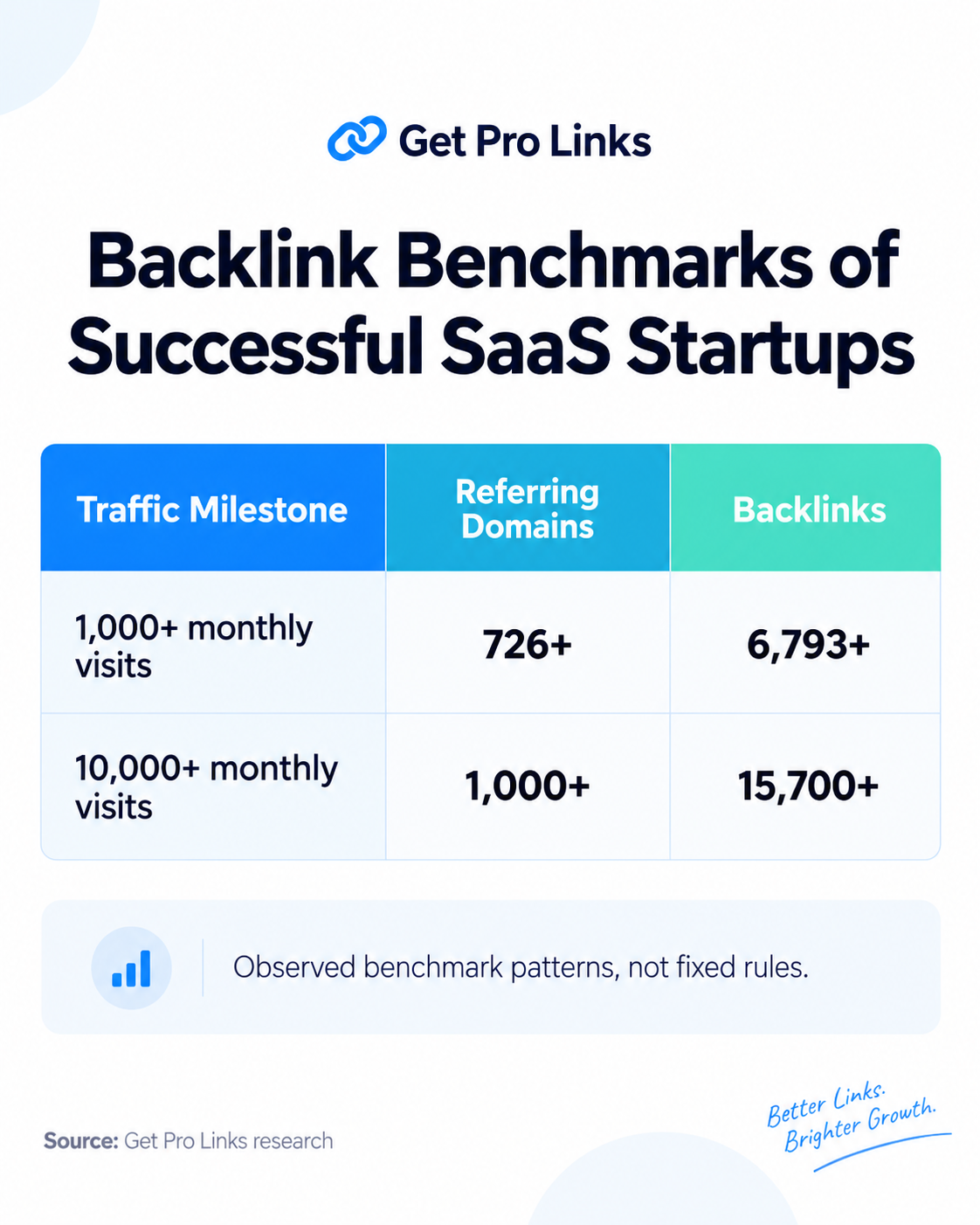
In our study, among SaaS products that had reached at least 1,000 monthly organic visits, roughly 61% had accumulated 726 or more referring domains. Around the same proportion had built at least 6,793 backlinks.
The pattern became stronger at the top end. Among the products attracting more than 10,000 estimated monthly organic visits, approximately 61% had crossed 1,000 referring domains, while the same percentage had accumulated more than 15,700 backlinks.
Those numbers are not recommendations. A niche SaaS company can rank with far fewer links, while a startup competing against Salesforce or HubSpot might require much more.
The better use of these numbers is as evidence of a broader pattern: the SaaS companies achieving serious organic visibility were rarely doing so with an insignificant off-site footprint.
For an individual startup, backlink requirements should therefore be based on the actual SERPs it wants to compete in. Look at the authority of the pages already ranking, the unique domains linking to them and the strength of the sites behind them. That tells you much more than an arbitrary target such as “we need 20 links every month.”
Link Building Is Also a Distribution Strategy
SEO tends to dominate conversations about backlinks, but rankings are only part of their value.
A relevant editorial mention can put a SaaS product in front of exactly the audience it wants to reach. If an HR software company is included in a respected HR publication, or a cybersecurity platform is referenced in a security research article, that placement carries meaning independently of what happens to rankings the following week.
This matters because young SaaS brands usually have a trust problem as much as a visibility problem.
People encountering an unfamiliar product naturally look for external validation. They want to see who is talking about it, which companies use it, what experts think of it and how it compares with alternatives.
Good SaaS link building creates those external touchpoints.
That is why relevance should carry more weight than a domain-level metric in isolation. A contextual mention in a publication read by your actual buyers can provide SEO value, referral exposure and brand credibility at the same time. A random backlink from a completely unrelated site may provide none of those things, regardless of how impressive the site’s DR looks in an outreach spreadsheet.
More Backlinks Are Not Automatically Better Backlinks
This is also where our study produced one of its most useful findings.
If backlink quantity alone created organic growth, sites with enormous backlink profiles should consistently outperform sites with smaller ones.
They did not.
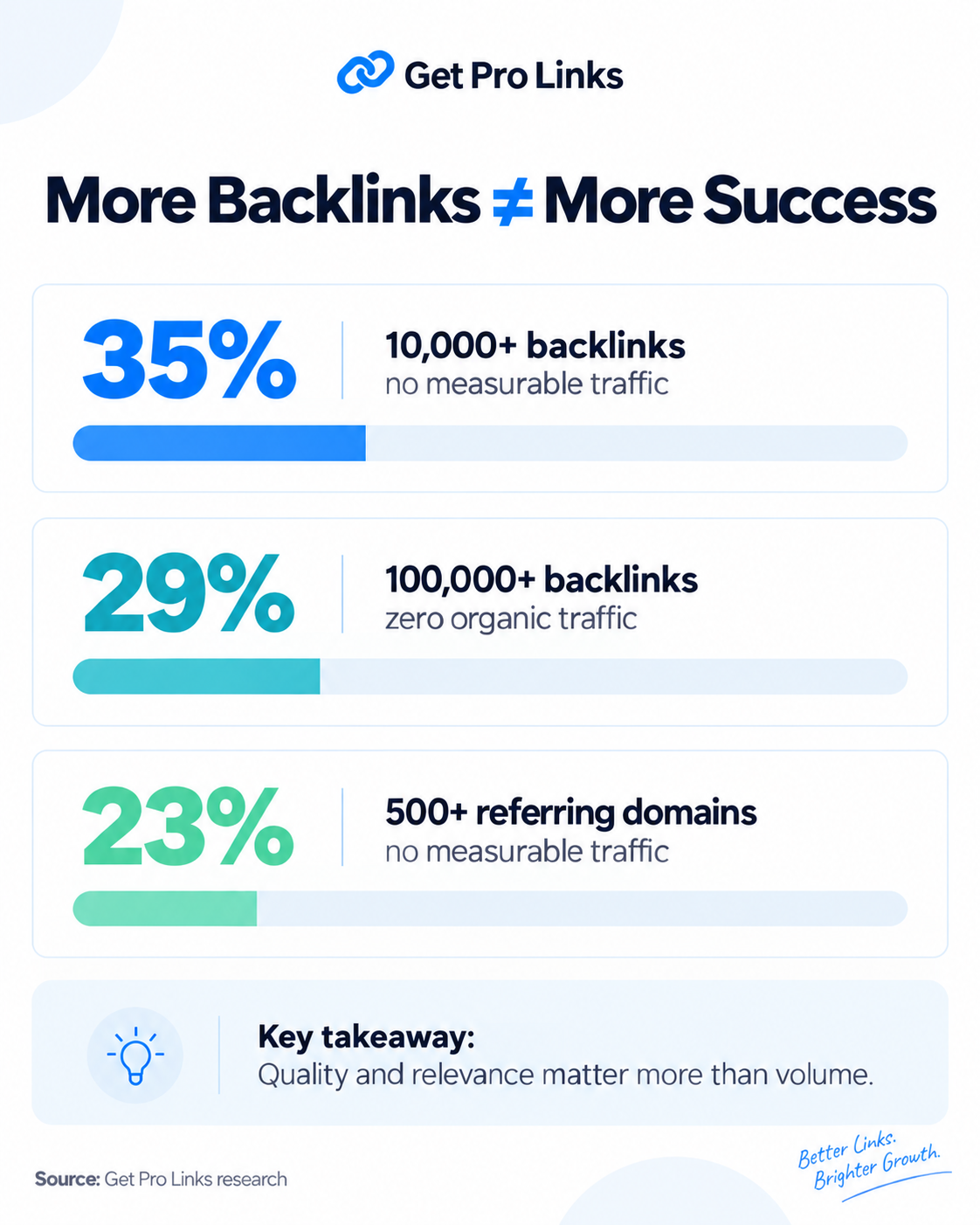
Among the SaaS websites in our dataset that had 10,000 or more backlinks, roughly 35% still had no measurable organic traffic.
The same problem existed at an even larger scale. Among websites with more than 100,000 backlinks, approximately 29% still recorded zero organic traffic.
Even a large number of referring domains offered no absolute guarantee. Roughly 23% of the websites with at least 500 referring domains still had no measurable organic traffic.
Our dataset cannot tell us that those links were spammy or irrelevant; doing so would require page-level analysis of the linking websites. What it can tell us is that volume alone did not produce results.
That distinction is essential for SaaS founders.
A backlink campaign built around quantity can easily become an exercise in improving spreadsheet metrics rather than building search visibility. Google explicitly warns against link schemes designed primarily to manipulate rankings, while its broader Search Essentials guidance continues to emphasize helpful, reliable, people-first content.
The objective should not be to collect as many backlinks as possible. It should be to earn credible references from websites that make sense for the business.
Good SaaS Link Building Strengthens the Whole Search Funnel
Another mistake is assuming that every backlink should point to the homepage.
A SaaS website usually has several different types of pages doing different jobs. Research, statistics, templates and free tools can introduce the company at the top of the funnel. Integrations, industry solutions and use-case pages help prospects understand where the product fits. Alternatives, comparison pages, feature pages and solution pages can capture people who are much closer to choosing a product.
A strong SaaS link-building strategy supports that wider search journey.
Sometimes the most linkable asset will be original research that naturally attracts publishers. That authority can then be distributed internally to important commercial pages. In other cases, a comparison or integration page may itself earn editorial links because it genuinely helps the reader.
What matters is that link acquisition and content strategy are working toward the same commercial goal.
A startup does not benefit much from doubling its domain-level backlink count if all of that authority is concentrated on pages that never participate in customer acquisition.
Link Building Now Has an AI Visibility Dimension Too
The search journey is also becoming broader.
A potential SaaS buyer might still begin with Google, but they may also ask ChatGPT, Gemini, Perplexity or Google AI Mode to recommend products, compare vendors or explain which platform is best for a particular use case.
That makes third-party presence increasingly important.
Ahrefs’ 2026 analysis of search trends, drawing on research across 75,000 brands, found that branded web mentions showed correlations of roughly 0.66 to 0.71 with AI visibility across major AI search experiences. Its broader conclusion is particularly relevant to link building: being discussed across the web appears to matter more for AI brand visibility than simply accumulating raw backlink volume.
Semrush’s 2026 research adds another useful wrinkle. In an analysis of brand appearances across ChatGPT, Google AI Overviews, Gemini and AI Mode, 61.7% of citations were “ghost citations”—the source was linked, but the brand itself was not named in the response. Comparative content, meanwhile, generated considerably more brand mentions than purely informational content.
For SaaS marketers, this changes the question.
Instead of asking only, “Can this website give us a backlink?”, it is worth asking, “Can this placement help establish what our brand is known for?”
A strong editorial placement can do both. It gives search engines a contextual reference while placing the company’s name, category and expertise into the wider information ecosystem that AI systems increasingly retrieve from.
So, When Should a SaaS Startup Start Building Links?
Earlier than many founders assume, but not before the fundamentals exist.
A weak product website does not become strong because links are pointed at it. Before serious outreach begins, the startup should have clear positioning, pages targeting real search demand, a technically crawlable website and content that deserves to be referenced.
Once those pieces are in place, there is little strategic benefit in waiting a year to begin building authority.
Links compound. A useful resource that earns visibility can attract further citations. A strong editorial mention can lead to branded searches. A partnership can create referral traffic and additional coverage. A page that begins ranking becomes easier for writers and journalists to discover organically.
That compounding effect is particularly valuable to SaaS startups because they are usually competing against companies that started accumulating authority long before them.
The Real Importance of Link Building for SaaS Startups
Link building is not a shortcut around product-market fit, good content or technical SEO. It cannot manufacture search demand, and our own research shows that even enormous backlink counts can coexist with zero organic visibility.
But the opposite result from the study is equally important.
The SaaS products that built stronger, more diverse backlink profiles during their first year were substantially more likely to develop organic search traffic. The gap between the strongest and weakest referring-domain groups was not marginal; it was dramatic.
In 2026, that matters even more because software itself is becoming easier to create. When professional developers are using AI coding agents every day and thousands of new products are entering the market every month, simply shipping a competent SaaS product is no longer enough to guarantee attention.
A startup has to earn its place in the wider web.
It needs useful pages worth ranking, relevant websites willing to reference it, publications willing to discuss it, partners willing to associate with it and customers able to discover it outside the company’s own marketing channels.
That is the real value of SaaS link building.
It does not just build backlinks. It helps turn an unknown product into a brand that the web and increasingly AI-powered search has a reason to recognize.
Want to Build Authority and Rank Your SaaS Brand?
If you want your SaaS brand to compete for valuable search terms, publishing great content alone may not be enough, you also need the authority to support it. That means earning relevant, high-quality links from websites that actually make sense for your product and audience. If you do not have the time, relationships, or outreach resources to manage this consistently, working with a specialist SaaS link-building agency can help. Get Pro Links focuses specifically on SaaS link building, helping software brands build relevant editorial links that support rankings, visibility, and long-term organic growth.
Frequently Asked Questions
Why is link building important for SaaS startups?
Link building helps a new SaaS website develop off-site authority, compete for valuable search queries, gain referral exposure and establish third-party credibility. Our study also found that SaaS products with stronger referring-domain profiles were significantly more likely to generate measurable organic traffic after their first year.
How many backlinks does a SaaS startup need?
There is no universal number. The appropriate benchmark depends on the competitiveness of the keywords and category you are targeting. The backlink profiles of pages already ranking for your highest-value queries are usually more useful benchmarks than a generic monthly link quota.
Are referring domains more important than total backlinks?
Total backlinks provide useful context, but unique referring domains often reveal more about the breadth of a website’s authority. Thousands of repeated links from a small number of websites are not equivalent to editorial references earned across many independent domains.
Does SaaS link building help with AI search visibility?
It can contribute when link building also creates relevant third-party brand mentions and contextual references. Recent AI visibility studies suggest that widespread brand mentions across the web have a much stronger relationship with AI visibility than raw backlink volume alone.
Ali Haider
Ali Haider is a Link Building Manager with 7 years of experience in SEO, digital outreach, and authority-building strategies. He specializes in developing effective link acquisition campaigns, managing outreach processes, and helping websites improve their online visibility through sustainable SEO practices.