
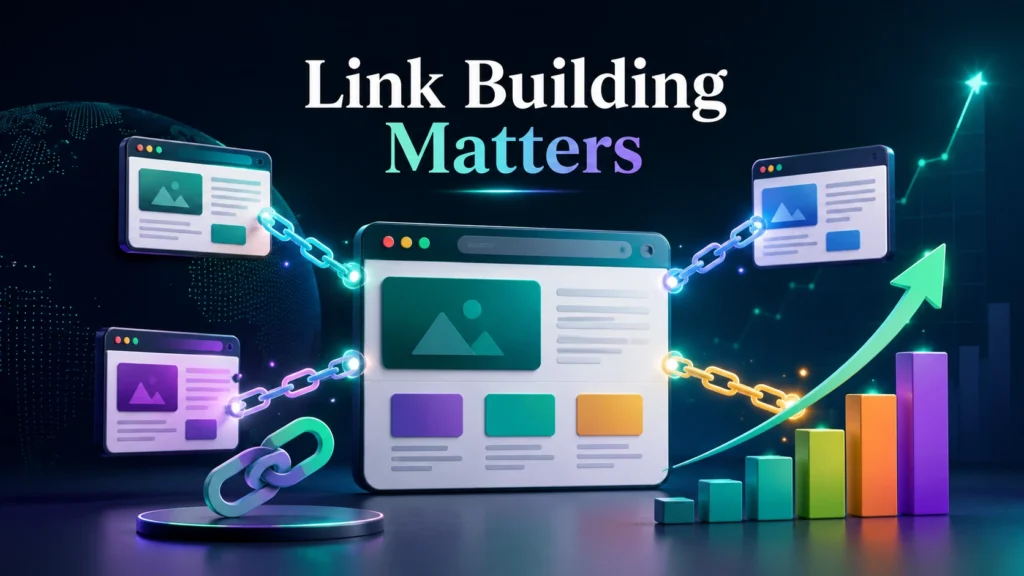
A lot of website owners focus entirely on content and forget the other half of SEO. This is exactly why link building is important, since it works alongside your content to help search engines find, trust, and rank your pages.
Backlinks are links from other websites pointing to yours and carry real weight in how Google evaluates a site, even as search continues to change year after year. This guide breaks down what link building actually does, why search engines rely on it so heavily, and how it can shape the long-term success of your website.
Basics of Link Building and Backlinks
Before getting into how link building works, it will be helpful to understand a few basic terms first.
Link building is the process of earning links from other websites that point back to your own site. Search engine crawlers, which are automated programs that scan the web, use these links to travel from page to page and discover new content.
A link found on a trusted site often tells the crawler that your page is worth exploring too, almost like a signpost pointing traffic and attention in your direction. It also helps to understand the difference between internal and external links.
Internal links connect pages within your own website, while external backlinks come from other domains entirely, and this is where the concept of the importance of outbound and inbound links comes in, since both types serve different purposes in guiding both users and search engines through your content.
Inbound links build trust from outside sources, while outbound links show search engines what topics and resources your own content connects to.
Why Search Engines Place So Much Value on External Links
Once a search engine understands your basic site structure, it still needs a way to judge how trustworthy and relevant your content actually is compared to everyone else’s.
Backlinks act like digital votes of confidence. When another website links to your page, it is essentially telling search engines that your content is useful enough to reference. This is part of the answer to why link building is important, since Google’s ranking systems weigh these votes as one signal among many when deciding where to place a page in search results.
A recent analysis of 11.8 million Google search results found that the number one ranking page carries close to 3.8 times more backlinks on average than pages sitting in positions two through ten, which shows just how closely link volume tends to line up with strong rankings.
Links remain one of the most consistently referenced search engine ranking factors across nearly every major SEO study published in recent years.
The Direct Benefits of Building High-Quality Backlinks
Beyond the theory, link building brings a set of very practical benefits that directly affect how your website performs day to day.
Higher Search Engine Rankings and Better Visibility
Earning quality links is often what pushes a page from the second results page onto the first one. Sites with a strong overall link profile also tend to rank faster for brand new keywords, since search engines already view the domain as established and trustworthy from previous link signals.
Increased Organic Search Traffic Over Time
Higher rankings translate directly into more clicks, since top positions capture the largest share of search traffic by a wide margin. Steady, consistent link building tends to produce predictable, compounding visitor growth, making it one of the more reliable organic traffic growth strategies available compared to one-time traffic spikes from social media or paid ads.
Direct Referral Traffic From Other Relevant Websites
Backlinks do not only help with rankings, but they also send real visitors directly to your site whenever someone clicks the link on the page it appears on. Referral traffic coming from a respected industry blog often converts better than average, simply because visitors arrive with a level of trust already built in from the site that referred them.
How Link Building Establishes Brand Authority and Trust
Rankings and traffic are only part of the picture. Link building also plays a major role in shaping how your brand is perceived across your entire industry.
Building Credibility in Your Specific Business Niche
Getting mentioned and linked from major sites in your industry makes your brand look more credible to both readers and search engines. Search engines also study anchor text, which is the clickable text used in a link, to understand which topics your business is closely associated with, reinforcing your relevance for related searches over time.
Over time, this pattern of mentions and links helps establish your brand as a recognized name within your niche, rather than just another unfamiliar website competing for attention.
Speeding Up Search Engine Indexing for New Pages
Web crawlers follow external links to discover new content faster than they would by relying on your own site alone. Sites that already carry strong authority tend to get crawled and updated more frequently, which means new articles or product pages often get indexed and start appearing in search results sooner.
The Role of Link Building in Outperforming Your Competitors
Good content alone is rarely enough to beat competitors who have already built a strong presence in your space. A well-written article can still lose to a weaker one that simply has more trusted sites vouching for it, which is another practical answer to why link building is important whenever you are competing for a crowded, competitive keyword.
This is where competitor link gap analysis becomes useful, since studying which sites link to your competitors but not to you reveals real, actionable opportunities you may be missing entirely.
A strong, well-earned link profile also acts like a defensive moat, making it harder for newer competitors to unseat your top rankings once they are established.
Quality Versus Quantity in Modern Link Building Strategies
Not all backlinks carry equal weight, and chasing raw numbers alone can actually work against you. One link from a highly trusted, relevant site is worth far more than hundreds of weak, unrelated ones.
Domain authority and SEO performance tend to move together for exactly this reason, since authority scores are built largely from the quality of a site’s linking sources rather than sheer link count. Fast link schemes and automated spam tactics carry real risk too, often triggering penalties that can undo months of legitimate progress.
The safer, more durable path is earning natural links through genuinely valuable content and honest outreach to real site owners, which supports both website credibility and trust and long-term ranking stability. This is also part of the broader picture of off-page SEO importance, since actions taken outside your own website often influence rankings just as much as the work you do on it.
Conclusion
The importance of link building ultimately comes down to trust. Search engines, readers, and even other website owners all use links as a signal of value, and a strong backlink profile touches nearly every part of SEO performance, from rankings and traffic to brand credibility and long-term stability.
Recent industry survey data shows that around 95% of SEO professionals still consider backlinks either critical or very important to search performance today, which reflects just how central this practice remains even as search continues to evolve. The right approach to link building, focused on quality over shortcuts, remains one of the most reliable ways to grow a website’s visibility over time.
If you are looking for SaaS link building that actually drives results. Get high-quality, relevant backlinks with Get Pro Links and take your SaaS SEO to the next level.
FAQs
What are the main benefits of backlinks?
The benefits of backlinks include stronger rankings, more organic traffic, direct referral visitors, and greater brand credibility within your industry.
Is link building still worth doing in 2026?
Backlinks remain one of the most consistently referenced ranking signals, and most SEO professionals still treat them as a core part of any serious strategy.
How many backlinks does a website actually need?
There is no fixed number, since quality and relevance matter far more than raw link count, and even a handful of strong links can outperform hundreds of weak ones.