
Semrush is one of the most well-known SEO platforms on the market, but it is not the right fit for everyone. Between its pricing, its learning curve, and features many smaller teams never touch, plenty of marketers go looking for the best Semrush alternative that fits their budget and workflow better.
Some teams need a tool built purely for backlink research, others want something simple enough for a beginner to pick up in a day, and some just want the same core SEO basics without the enterprise price tag.
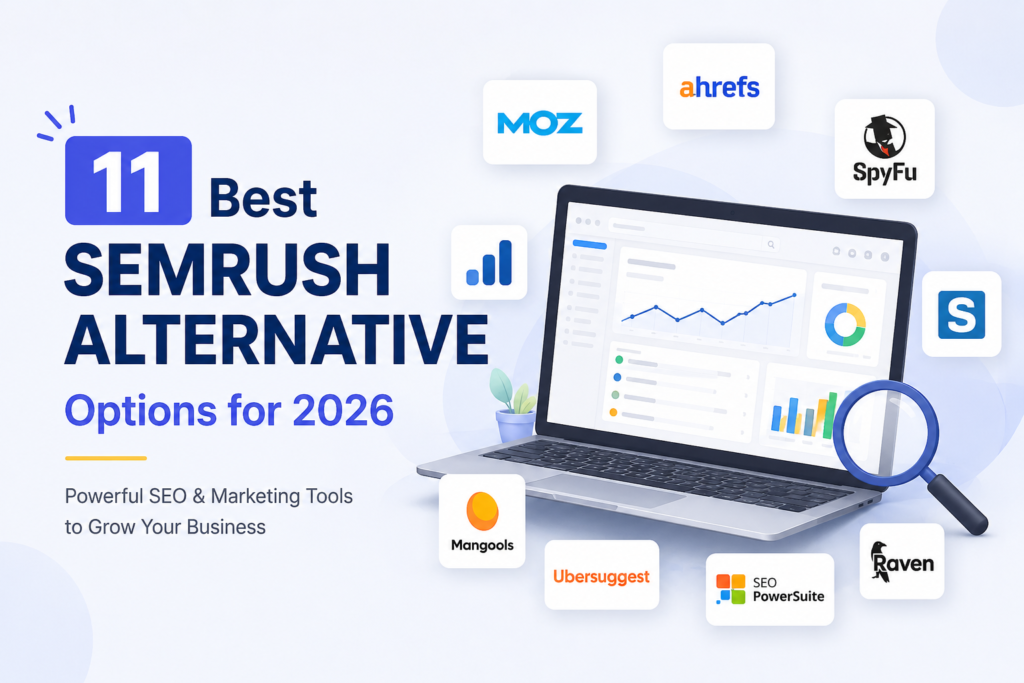
This guide compares eleven strong options, covering what each one does well, where it falls short, and what it actually costs, so you can pick the tool that fits your team instead of paying for features you will never use.
Key Takeaways
- Ahrefs: Best overall competitor for deep backlink analysis, web crawling accuracy, and organic keyword discovery.
- Moz Pro: Best for reliable domain authority metrics, easy page auditing, and user-friendly keyword rank tracking.
- SpyFu: Best budget platform for historical PPC advertising analysis, competitor ad copy research, and domain tracking.
- Similarweb: Best enterprise solution for web traffic intelligence, referral source tracking, and broad market research.
- Ubersuggest: Best affordable entry point for beginner marketers, small site owners, and basic keyword research tasks.
- SEO PowerSuite: Best desktop software suite offering unlimited project management and lifetime license value.
- Nightwatch: Best specialized rank tracker for hyperlocal search monitoring and multi-location reporting.
- Raven Tools: Best choice for marketing agencies needing automated white label client reporting and simple interface layouts.
- cognitiveSEO: Best for technical site audits, backlink toxicity detection, and algorithmic penalty recovery.
- Sistrix: The best European market data provider, featuring proprietary visibility index tracking and SERP analysis.
- Mangools: Best user-friendly toolset featuring intuitive interfaces for quick keyword analysis and SERP checking.
Why Look for a Semrush Alternative
While Semrush provides an expansive suite of digital marketing features, its core offerings do not align with every user’s daily budget or operational needs. Modern marketing teams often realize that paying for a massive, multi-purpose database is unnecessary when their primary focus is limited to keyword tracking or backlink monitoring.
High Pricing for Small Teams
Semrush’s plans start well above what many freelancers, solo consultants, and small businesses want to pay every month. For teams with a tight budget, that cost alone is often reason enough to look for Semrush alternatives for small business use instead of paying for an enterprise-level plan.
Steep Learning Curve
Semrush packs in a huge number of features, from SEO and PPC research to content tools and social media tracking. That range is powerful, but it also means new users often spend weeks getting comfortable with the interface before they feel confident using it well.
Feature Overlap You May Not Need
Many Semrush users only rely on a small slice of what the platform offers, such as keyword research or backlink analysis, while paying for a much larger suite of tools they rarely open. Several SEO tools like Semrush on this list cover those same core basics at a fraction of the cost.
Features like PPC research, social media tracking, and content marketing tools sound useful on paper, but if your team never touches them, they simply add cost without adding value. A more focused, cheaper tool can cover the same core needs without the extra cost, which is exactly why so many smaller teams end up switching to a leaner platform.
How We Evaluated These Semrush Alternatives
To provide an accurate and actionable comparison, each platform on this list was evaluated across four strict metrics:
- Core functionality
- Database accuracy
- User experience
- Overall value
I analyzed each platform’s keyword index size, backlink crawling speed, local search capabilities, and interface responsiveness.
Additionally, we verified all entry-level pricing, plan add-ons, user seat costs, and upgrade tiers as of 2026 to ensure complete financial accuracy.
11 Best Semrush Alternatives to Consider
Here are eleven tools worth considering if you are exploring the best alternatives for Semrush for your own SEO work.
1. Ahrefs
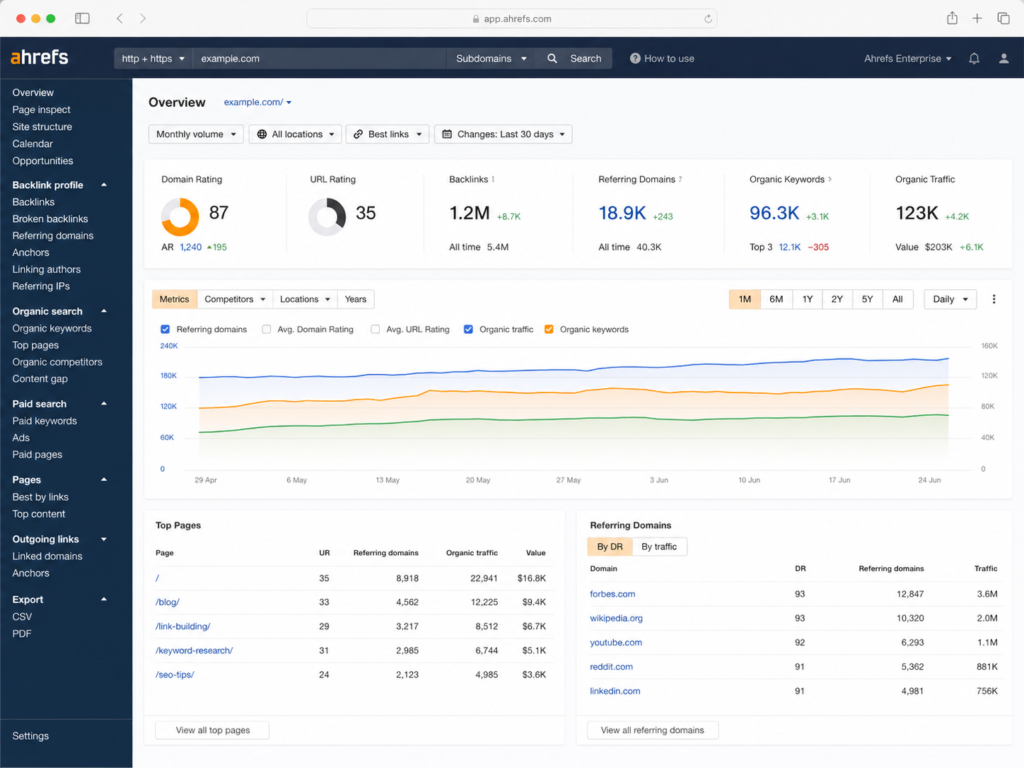
Ahrefs is one of the most respected names in SEO software, largely because of the size and freshness of its backlink database. It can be the best Semrush alternative for you. Beyond backlinks, it covers keyword research, competitor analysis, site audits, and content research in a single platform. It tends to appeal most to SEO specialists and agencies that need deep, reliable data rather than a simplified dashboard. While it shares several core features with Semrush, its overall approach feels more built for technical users who want to dig into the details rather than get a quick surface-level summary. Many SEO professionals treat it as their primary research tool even when they use a different platform for reporting or client work.
Key Features
- Site Explorer gives comprehensive breakdowns of organic search traffic, backlink records, and paid search metrics for any domain.
- Keywords Explorer provides click metrics, keyword difficulty scores, and search volume estimates across multiple global engines.
- Content Explorer helps users discover top-performing online content assets based on social shares and backlink acquisition rates.
Pros
- Very large, frequently updated backlink database
- Strong competitor and keyword research tools
- Detailed filters that help you avoid weak or spammy sites
- Well regarded among SEO professionals and agencies
Cons
- Steeper learning curve for beginners
- Higher cost compared to lighter tools on this list, so it is not always the cheaper alternative to Semrush that budget-conscious teams are searching for
Pricing
Ahrefs offers a basic Starter plan at $29 per month for lightweight tracking, while core plans include Lite at $129 per month and Standard at $249 per month. Advanced agency tiers scale up to $449 per month, with additional manager seats costing between $40 and $100 per month depending on access level.
2. Moz Pro
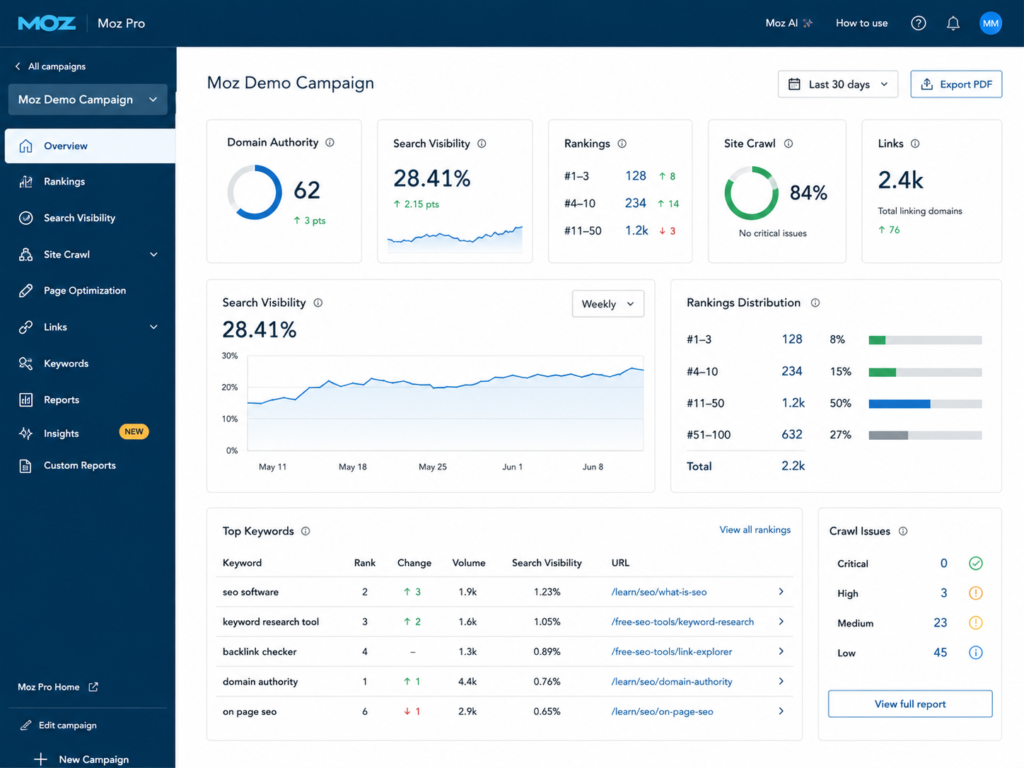
Moz Pro is one of the older names in SEO software, and it built its reputation on being easier to learn than more complex platforms. It covers the core basics well, including keyword research, rank tracking, site audits, and backlink analysis, wrapped in an interface designed to feel approachable for people who are newer to SEO. It is not the most powerful or actively developed tool on this list, but for smaller teams or beginners who mainly need the fundamentals covered clearly, it remains a solid, low-pressure starting point. Many users who started their SEO career on Moz Pro stick with it simply because they already understand how it works.
Key Features
- Keyword Explorer offers keyword suggestions, SERP analysis, and unique metrics like Organic Click-Through Rate potential.
- Link Explorer provides deep backlink profile evaluation, anchor text analysis, and proprietary Spam Score ratings.
- Site Crawl identifies technical page errors, broken links, duplicate content issues, and missing meta elements automatically.
Pros
- Easier learning curve for SEO beginners
- Clear explanations paired with technical audit issues
- Solid all-around toolkit for smaller teams
Cons
- Data freshness can lag behind Ahrefs or Semrush
- Fewer advanced features for larger, more complex sites
- Slower pace of new feature development
Pricing
Moz Pro offers a basic Starter plan at $49 per month for small sites, while its Standard plan costs $99 per month. Mid-sized teams typically choose the Medium plan at $179 per month, while large agency packages cost $299 per month.
3. SpyFu
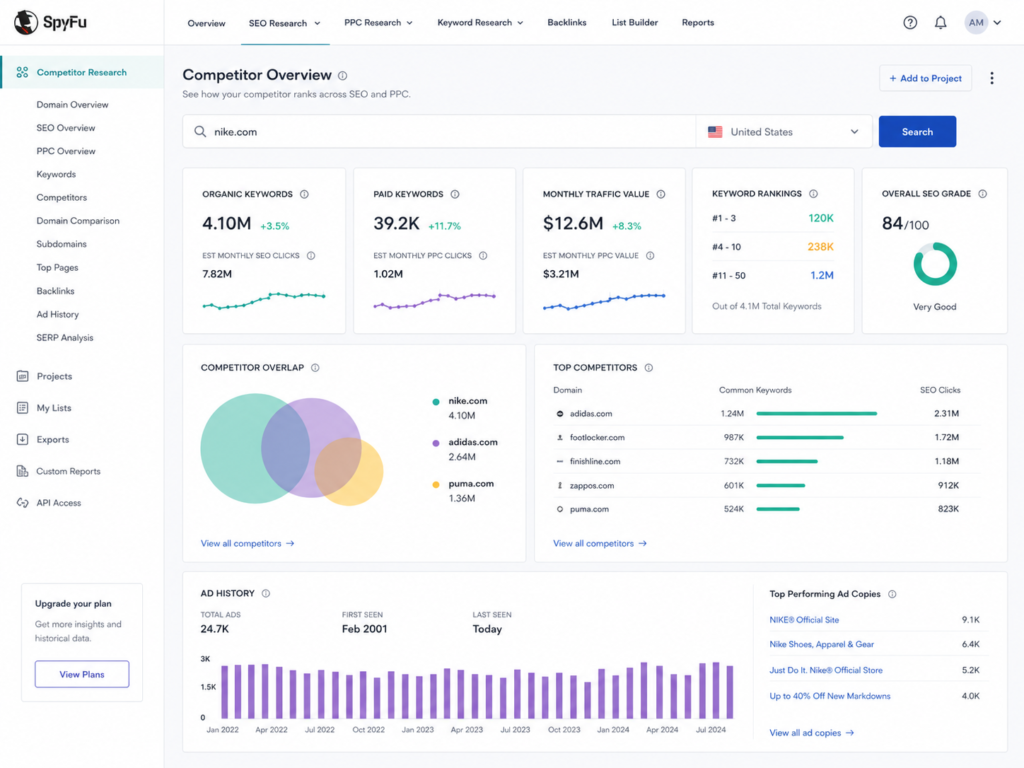
SpyFu built its name around competitor research, particularly for pay-per-click advertising, and it remains one of the most budget-friendly options for teams that care most about seeing what competitors are doing. It shows historical ad copy, estimated ad spend, and keyword strategies competitors have used over time, which makes it especially useful for teams running both SEO and paid search. Its SEO toolset is lighter than Ahrefs or Semrush, so it works best as a competitive research tool rather than a full technical SEO suite. Agencies pitching new clients often use it to quickly show where a prospect is losing ground to competitors.
Key Features
- Competitor PPC analysis reveals historical ad spending, ad variations, and successful negative keyword lists.
- Kombat Keyword Tool highlights overlapping keywords between multiple competitors to uncover hidden content opportunities.
- RivalFlow AI automatically analyzes top-ranking competitor pages and suggests text improvements to capture higher search rankings.
Pros
- Very affordable compared to most full-featured alternatives
- Strong competitor PPC and keyword research tools
- Simple, easy-to-navigate dashboard
Cons
- Lighter technical SEO and site audit features
- Smaller backlink database than Ahrefs or Semrush
- Basic rank tracking compared to specialized tools
Pricing
SpyFu’s basic plan starts around $39 a month, making it one of the most affordable tools on this list for competitor-focused research.
4. Similarweb
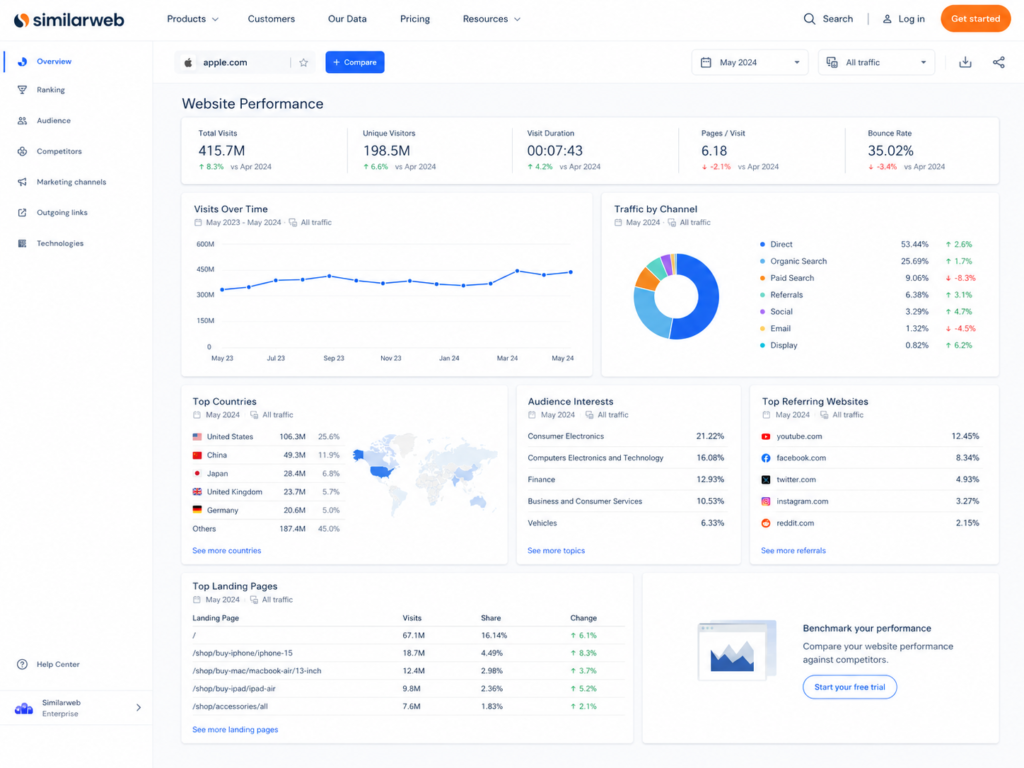
Similarweb takes a different approach than most tools on this list, leaning more toward web traffic analysis and market research than traditional SEO metrics. It does include SEO features like keyword research, rank tracking, and backlink analysis, but these sit alongside a much larger set of tools built for market benchmarking and competitive traffic analysis. It fits best for teams that want a broader digital intelligence picture, such as understanding where a competitor’s traffic actually comes from, rather than teams whose main need is deep technical SEO work. Marketing and strategy teams often use it alongside a dedicated SEO tool rather than as a full replacement.
Key Features
- Traffic and Engagement Analytics breaks down total visits, bounce rates, visit durations, and audience traffic channels.
- Referral Research tracks incoming web traffic sources, affiliate marketing networks, and partner websites.
- Category Analysis lets users benchmark their website performance against entire industry sectors and top market leaders.
Pros
- Strong traffic and market research capabilities
- Useful for understanding competitor audience sources
- Clear, well-organized dashboard layout
Cons
- Higher pricing compared to most SEO-focused alternatives
- Less depth in local SEO and content optimization
- Data accuracy can be inconsistent for smaller, lower-traffic sites
Pricing
Similarweb provides custom enterprise options, with specialized package tiers starting at $125 per month for competitive intelligence. Combined SEO and digital marketing plans start at $335 per month, while complete commercial packages reach $540 per month.
5. Ubersuggest
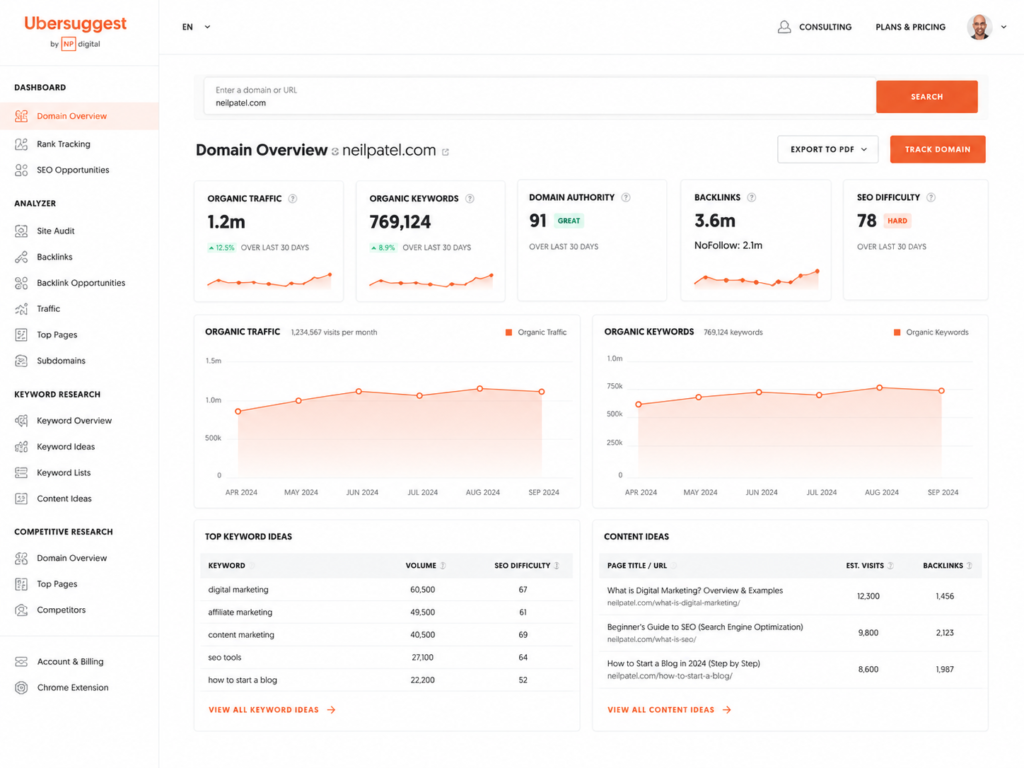
Ubersuggest was created by Neil Patel and has grown from a simple keyword tool into a more complete, though still lightweight, SEO platform. It covers keyword research, rank tracking, basic site audits, and backlink analysis, all wrapped in one of the simplest interfaces on this list. It is often recommended for beginners or small business owners who want the basics of SEO covered without a steep learning curve or a large monthly bill, though it does not match the data depth of larger platforms like Ahrefs or Semrush. Its low-cost entry point makes it a common first tool for people just starting to learn SEO.
Key Features
- Keyword Discovery generates actionable content ideas, search volume trends, seasonal patterns, and cost per click estimates.
- AI Writer generates automated content outlines, meta descriptions, and social media post copy in seconds.
- Site Audit scans web pages for technical errors, slow load speeds, and basic on-page optimization improvements.
Pros
- Very beginner-friendly interface
- Among the most affordable tools on this list
- Useful AI writing and content suggestion features
Cons
- Smaller keyword and backlink database than larger competitors
- Basic reporting compared to full-featured platforms
- Less suited for advanced technical SEO work
Pricing
Ubersuggest plans are remarkably low cost, starting with an Individual tier at $29 per month. Business plans cost $49 per month, while enterprise packages run $99 per month. Lifetime purchase deals are also offered between $290 and $990.
6. SEO PowerSuite
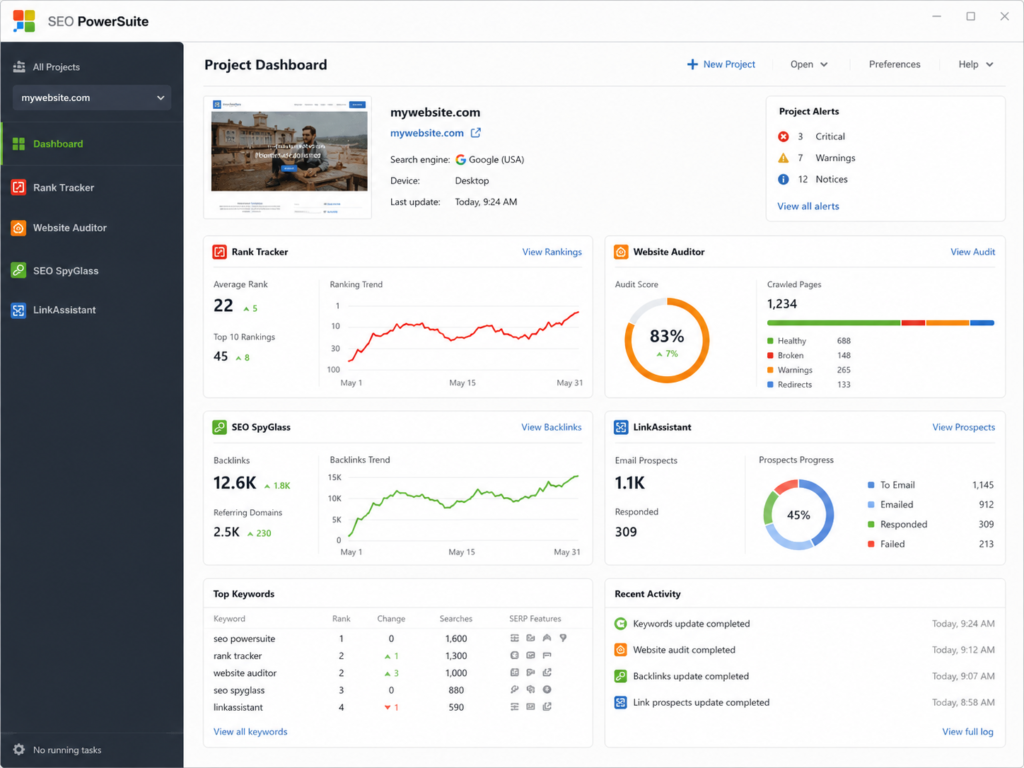
SEO PowerSuite stands out from nearly every other tool on this list because it uses a desktop-based, one-time annual license instead of a recurring cloud subscription. It bundles four separate applications, covering rank tracking, site audits, backlink analysis, and outreach for link building, all installed directly on your computer. This structure appeals most to freelancers and agencies who want unlimited keyword and project usage without monthly caps, though it does mean managing software locally instead of through a browser. Teams that dislike recurring subscriptions often find the annual license model refreshing compared to typical cloud-based SEO tools.
Key Features
- Rank Tracker monitors keyword positions across hundreds of local and international search engines with unlimited query tracking.
- A website auditor performs deep technical site crawls, checking internal linking structures, page speed, and Schema markup.
- SEO SpyGlass analyzes competitor backlink profiles and calculates domain penalty risks using advanced spam detection metrics.
Pros
- One-time annual license instead of monthly fees
- No keyword or project caps on most plans
- Full data ownership since it runs on your own machine
Cons
- A desktop-based setup feels less convenient than cloud tools
- Steeper learning curve across four separate applications
Pricing
SEO PowerSuite offers a free functional version with limited saving capabilities. The Professional plan costs $299 per year, while the Enterprise edition costs $499 per year, covering full client reporting and data export capabilities.
7. Nightwatch
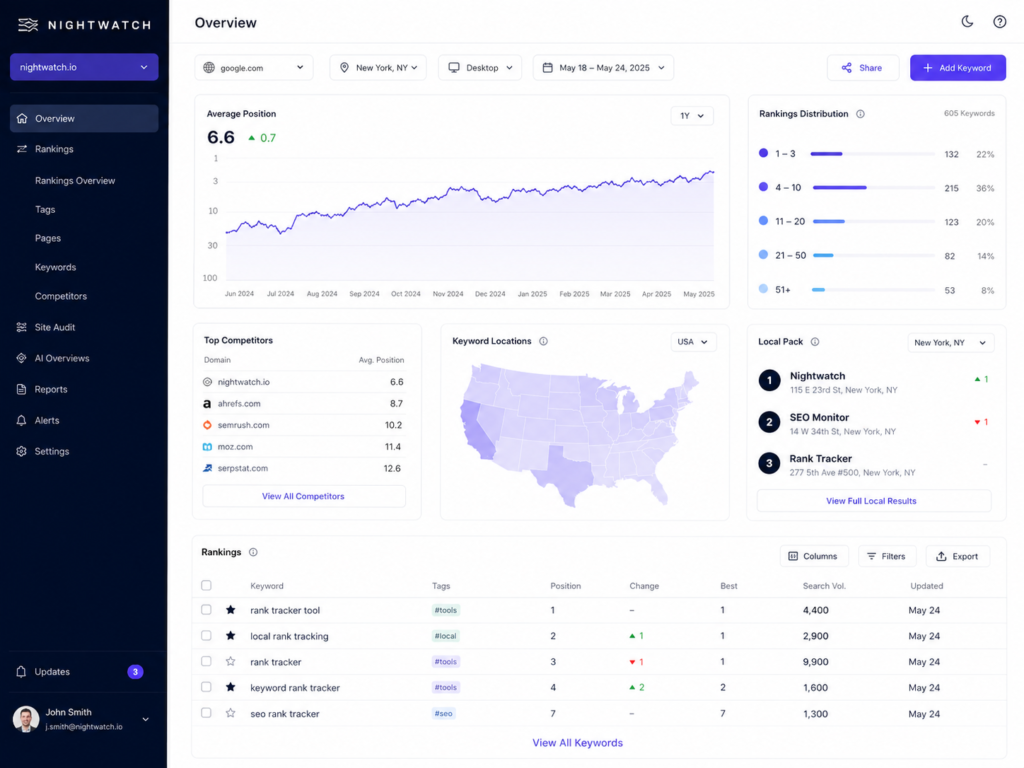
Nightwatch is a more focused tool built primarily around rank tracking, rather than trying to cover every part of SEO in one platform. It is known for accurate, detailed keyword tracking, including local and map-based rankings, along with white label reporting that agencies often rely on for client work. It is not designed to replace a full SEO suite, so teams that also need deep backlink or content research typically pair it with a second, more research-focused tool. Agencies managing many client sites often value it specifically for how clean and accurate its daily tracking feels compared to more general platforms.
Key Features
- Local Rank Tracking monitors organic search engine positions across precise geographic locations and Google Local Teaser packs.
- Automated Segmenting groups keywords automatically based on search volume, difficulty, tags, or ranking changes.
- Site Auditor scans web pages for technical issues, broken links, and mobile responsiveness problems.
Pros
- Highly accurate, frequently updated rank tracking
- Strong local and map pack tracking support
- Clean, agency-friendly white label reporting
Cons
- Not a full SEO suite on its own
- Limited backlink and content research features
Pricing
Nightwatch plans start with the Freelance tier at $39 per month for 250 tracked keywords. The business plan costs $99 per month for 1,250 keywords, while custom agency tiers start at $369 per month for large enterprise keyword volumes.
8. Raven Tools
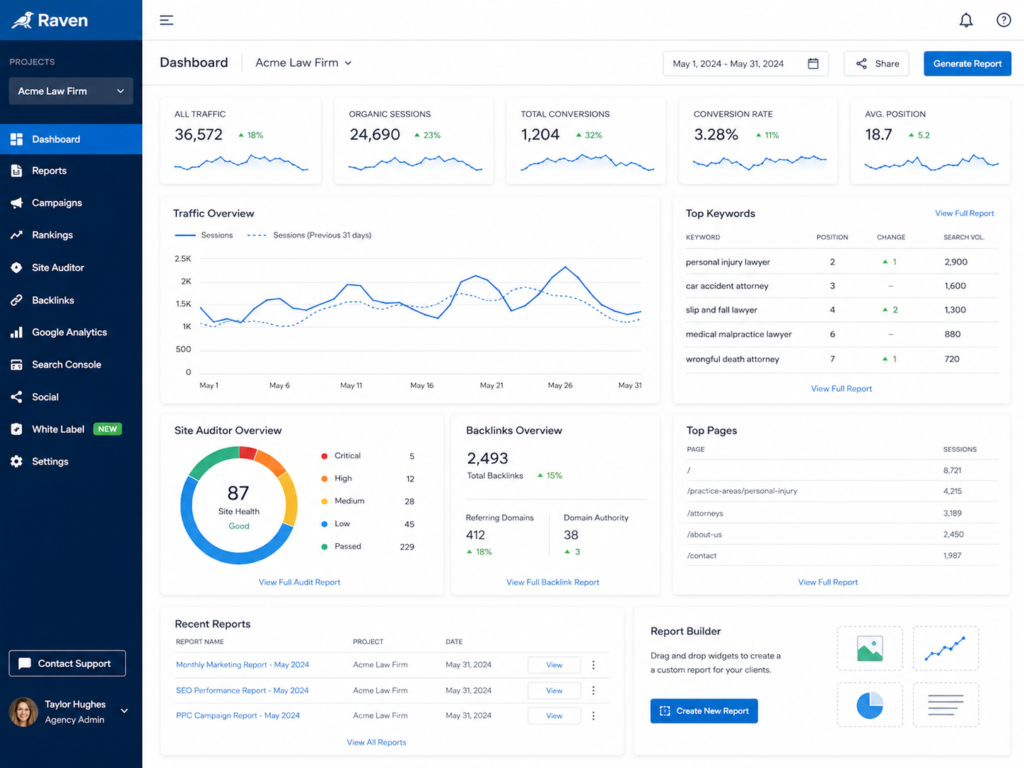
Raven Tools built its reputation around client reporting, offering one of the more polished white label reporting systems among mid-sized SEO platforms. It combines rank tracking, site audits, and backlink monitoring with detailed, brandable reports that agencies can hand directly to clients. Its keyword research and backlink data are lighter than larger platforms like Ahrefs, since it pulls some of its link data from third-party sources rather than running its own full-scale crawler. It tends to suit small agencies that value clean client-facing reports more than raw data depth.
Key Features
- Automated White Label Reporting builds scheduled PDF performance reports carrying custom agency logos and colors.
- Site Auditor analyzes web pages for technical search errors, speed issues, and mobile usability compliance.
- The Multi-Channel Dashboard consolidates data from Google Ads, Facebook Ads, Bing Ads, and social channels into one view.
Pros
- Well-regarded white-label reporting for client work
- Reasonable entry pricing for small agencies
- Combines reporting with core SEO tracking in one place
Cons
- Smaller keyword and backlink database than top-tier tools
- Basic site audit checks compared to more technical platforms
- Less suited for teams needing deep competitor research
Pricing
Raven Tools offers a Small Biz plan at $49 per month, a Start plan at $109 per month, and a Grow plan at $199 per month. Enterprise tiers like Lead cost $399 per month for high-volume client reporting needs.
9. CognitiveSEO
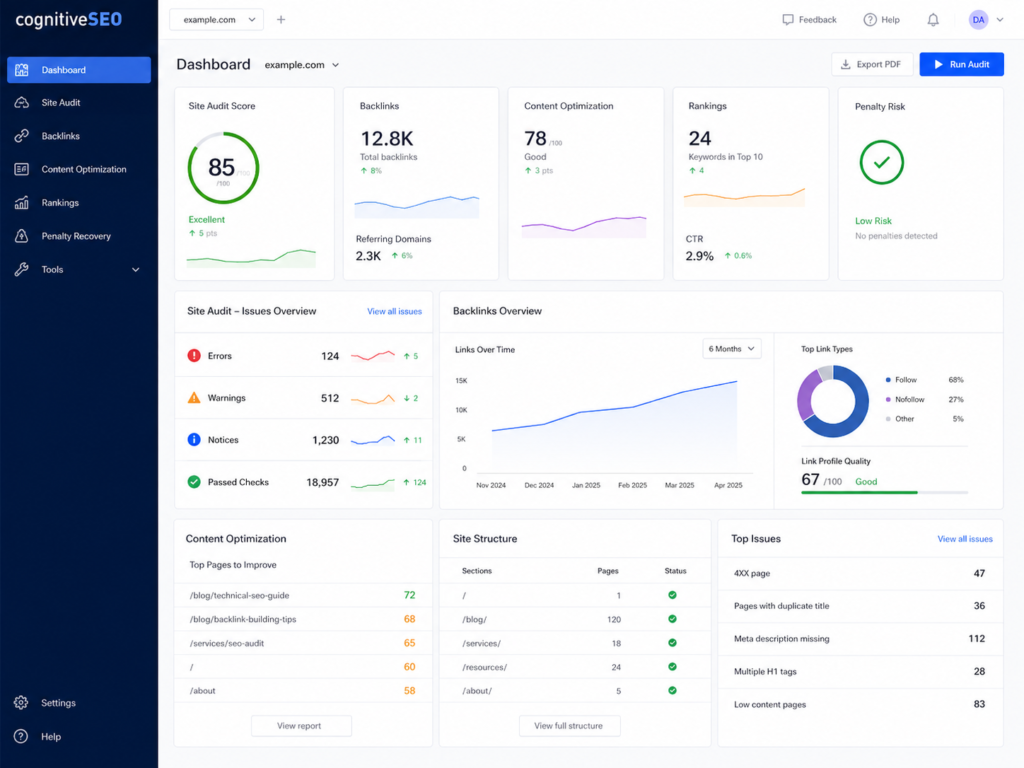
cognitiveSEO positions itself as a more specialized tool, focused heavily on backlink analysis, content optimization, and site audits rather than trying to match Semrush feature for feature. It offers detailed backlink tracking with tools for spotting unnatural link patterns, along with content audit features that help identify pages losing traffic or rankings over time. It sits on the pricier side for a lesser-known platform, which can make it a harder sell for smaller budgets, but its backlink and content tools are genuinely detailed for teams that need them. SEO teams recovering from a ranking drop often use it specifically to trace which links may have triggered the issue.
Key Features
- Unnatural Link Detection automatically identifies dangerous backlink sources and exports instant disavow files.
- Content Optimizer analyzes top-ranking web pages to suggest specific LSI keyword additions and semantic improvements.
- Site Auditor conducts deep technical crawls to uncover architectural errors, duplicate content, and indexing bottlenecks.
Pros
- Detailed backlink and unnatural link detection tools
- Useful content audit features for finding underperforming pages
- Solid on-page SEO auditing capabilities
Cons
- Higher starting price than many similarly sized tools
- Smaller brand recognition compared to Ahrefs or Semrush
Pricing
CognitiveSEO’s plans start around $129.99 a month, placing it closer to premium pricing despite its smaller market presence.
10. Sistrix
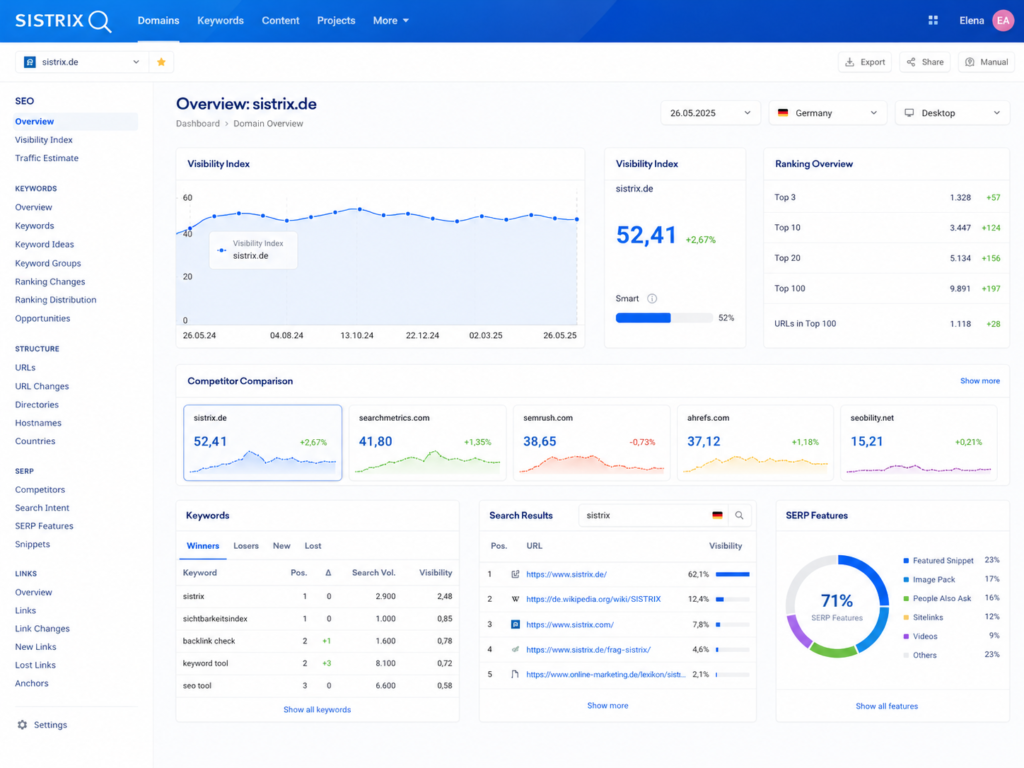
Sistrix is best known for its Visibility Index, a proprietary metric that has become something of an industry standard for tracking search visibility in Germany, Austria, and Switzerland. Outside of that core strength, it also offers keyword research, backlink analysis, and on-page SEO tools, though its overall backlink database is smaller than Ahrefs’. For agencies and businesses working primarily in European markets, especially German-speaking ones, Sistrix often provides data and context that broader global tools simply do not offer. Clients in that region frequently expect to see the Visibility Index in reports, which makes the tool almost a requirement rather than a preference.
Key Features
- • The Visibility Index calculates a domain’s overall search presence using historic SERP data collected over many years.
- The optimizer module checks web pages for technical errors, mobile load speeds, and structural architecture flaws.
- Keyword & SERP analysis uncovers keyword rankings, featured snippet opportunities, and user search intent shifts.
Pros
- Trusted, widely recognized visibility metric in European markets
- Long historical data range for tracking trends over time
- Strong fit for German and broader European SEO work
Cons
- Pricing runs higher than several other alternatives on this list
- Less useful for teams focused outside European markets
- Smaller backlink database compared to Ahrefs
Pricing
Sistrix operates on a modular pricing framework where individual modules start at €119 per month. Packages combining multiple core modules typically range between €299 and €499 per month for enterprise-level access.
11. Mangools
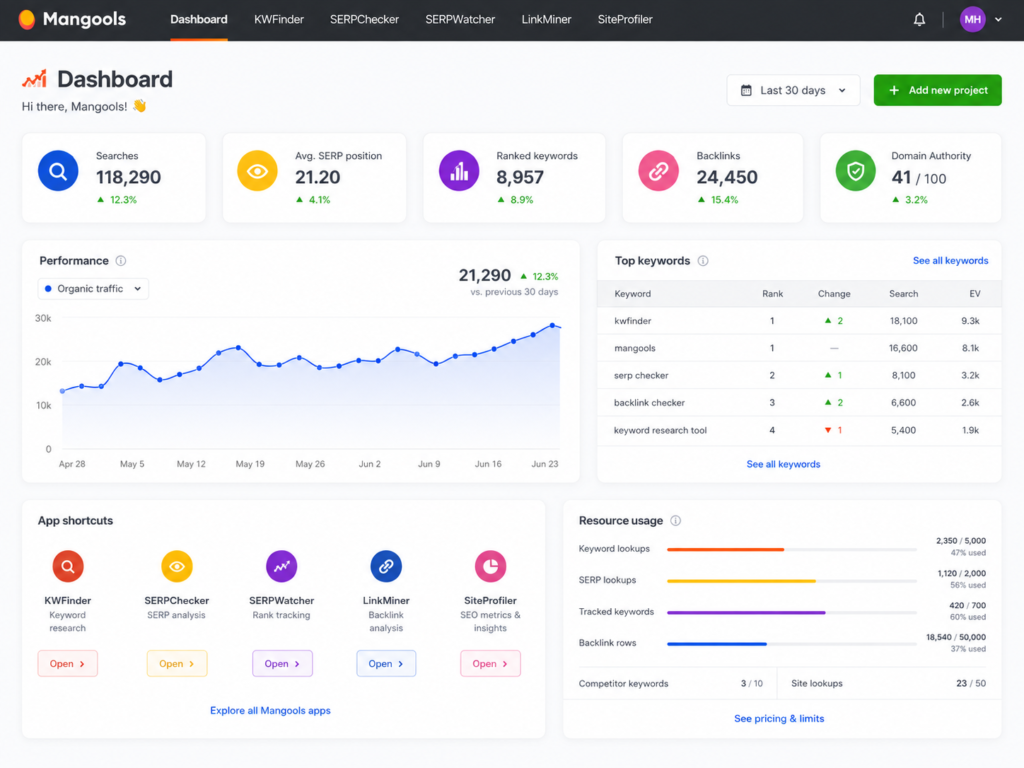
Mangools bundles five separate SEO tools, including KWFinder for keyword research and SERPWatcher for rank tracking, into one simple, affordable package. It is often recommended for beginners, bloggers, and small business owners who want an easy-to-use tool without the complexity or cost of larger platforms. Its data sets are smaller than Ahrefs’ or Semrush’s, so it is not built for large-scale enterprise SEO work, but for straightforward keyword research and rank tracking, it remains one of the more approachable options available. Freelancers managing a handful of client sites often find it covers everything they need without ever opening a more complex platform.
Key Features
- KWFinder generates low-competition keyword ideas with accurate search volume estimates and difficulty scores.
- SERPChecker provides detailed competitor breakdown analysis, feature preview checks, and search intent metrics.
- SERPWatcher delivers clear daily rank tracking updates with visual performance indexes and tracking alerts.
Pros
- Very affordable pricing for a five-tool bundle
- Clean, beginner-friendly interface
- Good starting point for keyword research and rank tracking
Cons
- Smaller keyword and backlink database than larger platforms
- Less suited for complex, large-scale SEO campaigns
Pricing
Mangools offers exceptional value, starting with an entry plan at $29 per month. The basic plan costs $49 per month, the premium plan costs $69 per month, and the agency plan costs $129 per month.
How to Pick the Right Semrush Alternative for You
Selecting the ideal search engine optimization platform requires a clear assessment of your daily marketing tasks, client reporting obligations, and monthly operating budget.
Assess Your Primary Marketing Tasks
If your daily operations revolve around deep link-building campaigns, competitor link mining, and technical backlink audits, Ahrefs or CognitiveSEO will serve as your best software choice. If your business focuses strictly on local service clients who need map pack visibility, a specialized rank tracker like Nightwatch provides superior geographic data accuracy. For content marketers and bloggers aiming to discover low-competition search queries quickly, Mangools or Ubersuggest offers everything you need without unnecessary complexity.
Match Software to Your Budget and Team Size
Solo website owners and small agencies should prioritize platforms that provide high data value without charging steep fees for extra user seats. Tools like SpyFu, SEO PowerSuite, and Mangools allow small teams to scale operations without facing sudden price spikes. Larger agencies managing dozens of client accounts should consider Raven Tools or Moz Pro for automated white-label reporting features that save hours of manual administrative labor each month.
Conclusion
There is no single best Semrush alternative that fits every team, since the right pick depends heavily on your budget, your workflow, and which parts of SEO matter most to your business. Ahrefs and Moz Pro offer strong all-around coverage, budget-friendly tools like Mangools and Ubersuggest work well for smaller teams, and specialized options like Sistrix and cognitiveSEO shine for more specific needs. Whichever tool you choose, the goal stays the same, find software that fits how you actually work rather than paying for a long feature list you will rarely use. Most of the tools covered here offer a free trial or a low-cost entry plan, so it is worth testing one or two directly on your own site before committing to a full year of any subscription.
FAQs
What is the cheapest Semrush alternative on this list?
Mangools and Ubersuggest are generally the most affordable options, with entry plans starting under 30 dollars a month, making them a good starting point for solo users or small blogs.
Is Ahrefs a good replacement for Semrush?
For teams focused heavily on backlink research and competitor analysis, though it has a steeper learning curve for beginners and lacks some of the broader marketing features Semrush offers.
Which Semrush alternative is best for small agencies?
Raven Tools and Nightwatch both offer strong white label reporting features that agencies often rely on for client work, though pairing either one with a research-focused tool like Ahrefs can round out the workflow.
Do any of these tools offer a free trial?
Most of the tools on this list, including Ahrefs, Moz Pro, and Similarweb, offer a free trial period, though the length and features included vary by platform, so it is worth checking each provider’s current terms before signing up.
Ali Haider
Ali Haider is a Link Building Manager with 7 years of experience in SEO, digital outreach, and authority-building strategies. He specializes in developing effective link acquisition campaigns, managing outreach processes, and helping websites improve their online visibility through sustainable SEO practices.